
Match Wood Panels to Working Conditions: A Field Guide
Match Wood Panels to Working Conditions: A Field Guide
Wood panels are usually described by category names: plywood, MDF, LVL, melamine board, veneered board. But what a project actually needs is determined by working conditions — the environment, the load, how the panel will be used, and the compliance standards that apply to the destination market.
For contractors, furniture manufacturers, packaging buyers, and distributors, matching the wrong wood panel to a project creates rework, schedule delays, and unnecessary material cost. This guide outlines a field-to-spec approach: start from project working conditions, map those conditions to panel properties, then choose the right wood panel type. It also explains how to verify a supplier’s execution capability before placing a container order.
Why “wood panel name” is not enough
Panel names group many different engineered wood products under one label. The term plywood can describe a 2 mm decorative furniture panel or a 35 mm film faced concrete formwork panel. MDF can range from 500 kg/m³ to 1000 kg/m³ in density, serving different structural and decorative roles. That is why buying by name alone is risky.
Project documentation often describes conditions more precisely than product names. In one outdoor decoration case, the panel’s role was decoration and protection under UV exposure in an outdoor environment, supported by installation systems and fasteners. In an industrial packaging scenario, the panel was used for crating and protection under heavy-duty transport, in one-time or reusable mode, with a special requirement for high load capacity. A furniture production scenario in a workshop environment required continuous production with a smooth surface and stable core. These are all wood panel applications, but each points to a different product specification.
Industry background: why project-fit selection matters now
The global engineered wood panel market is broad, and it continues to expand across applications. Grand View Research valued the global plywood market at USD 80.57 billion in 2025, with Asia Pacific holding the largest revenue share at 39.4%. The same research firm projected the global MDF market to grow from USD 44.96 billion in 2025 to USD 82.24 billion by 2033, at a CAGR of 8.2%. Wood Plastic Composites, a material family used in outdoor decking and cladding, reached an estimated USD 8.89 billion in 2025.
Regulatory pressure is another reason to match panels to project conditions. In the European Union, wood-based panels used in construction must meet the harmonized standard EN 13986 for CE marking. In the United States, EPA TSCA Title VI sets formaldehyde emission limits for composite wood products: 0.11 ppm for MDF and 0.05 ppm for hardwood plywood. OSB production also reflects the scale of the sector, reaching over 32 million cubic meters globally in 2024, with the USA accounting for 14 million cubic meters. Global leaders in the wood-based panel market — including West Fraser, Arauco, Kronospan, and EGGER Group — compete on scale, but for most buyers the more relevant task is making a defensible product selection for a specific site and market.
A five-condition framework for wood panel selection
The framework below organizes project information into five dimensions. Each dimension narrows the range of suitable wood panel products.
1. Working environment
Where will the panel be installed or used? Indoor dry conditions, outdoor UV exposure, high-moisture coastal zones, and concrete contact all place different demands on the panel.
An interior decoration project in the US, for example, was documented for an indoor dry environment with permanent installation and a specific requirement for eco-friendly, formaldehyde-free boards. An outdoor cladding project in Mexico required UV resistance and weather resistance, with the panel operating under long-term outdoor exposure.
2. Functional role
What is the panel expected to do?
- Structural support — building frames, roof and floor systems
- Decoration and protection — exterior cladding, wall panels
- Crating and protection — industrial packaging, heavy-duty transport
- Cabinet and furniture making — continuous workshop production
In an Australian building project, the panel was specified for structural support under outdoor structural use, with waterproof and high-strength requirements. In a Singapore packaging case, the panel was used for crating and protection under heavy-duty transport conditions.
3. Operation mode
How long will the panel stay in service, and how will it be handled?
- Permanent installation — wall cladding, building structure
- Continuous production — furniture panels, bed slats in high-volume production
- One-time or reusable — export crating, concrete formwork
A furniture manufacturer in Poland, for example, operates in workshop production conditions with continuous production mode. The panel must deliver a smooth surface and a stable core to support machining and finishing.
4. Special requirements
Projects often carry constraints beyond the basic panel category:
- Waterproof and high strength — building and marine construction
- High load capacity — industrial packaging
- Smooth surface and stable core — furniture and cabinet production
- UV resistance and weather resistance — outdoor wall cladding
- Eco-friendly, low formaldehyde — indoor decoration
These requirements determine the glue type, surface material, density, and veneer grade needed in the final specification.
5. Compliance requirements
Destination-market compliance is part of project fit. Dalian WADA International Trading Co., Ltd., a manufacturer and exporter established in 2010, supplies engineered wood panels with FSC, EUDR, CARB P2, EPA, JAS and JIS certifications. Buyers should verify that the panel selected for the project satisfies both the product standard (such as EN 13986 for EU construction use) and the emission limits of the destination market.
Step-by-step: from working conditions to wood panel specification
The following process moves a project team from site-level observations to a concrete product specification.
Step 1 — Record the working conditions
Write down the project location, environment, load expectations, duration of use, and any special constraints. Use the five-condition framework as a checklist.
Step 2 — Translate conditions into panel properties
Convert each condition into a measurable or verifiable characteristic. The table below shows the pattern.
| Project condition | Panel property required | Example product direction |
|---|---|---|
| Outdoor UV exposure, permanent cladding | WBP glue, weather-resistant surface, stable core | Marine plywood or structural plywood |
| Concrete formwork, repeated reuse | Film-faced surface, waterproof glue, high reuse cycles | Film faced plywood |
| Heavy-duty transport, high load | High load capacity, durable face and core | Commercial plywood |
| Furniture workshop, continuous production | Smooth surface, stable core, low formaldehyde | MDF, melamine board, veneered board |
| Bed frame components | High strength in thin cross-section | LVL bed slat |
Step 3 — Screen candidate panel types
Once the panel properties are defined, compare them with the available panel families: plywood, MDF, LVL, melamine board, veneered board, OSB, and specialty boards such as film faced plywood and marine plywood. Dalian WADA’s core product range also includes LVL, plywood, veneered board, MDF, OSB, wall panels, and woodworking machines, which gives buyers a practical basis for comparison within one supply relationship.
Step 4 — Verify glue, surface, and certification
For wet or outdoor applications, the glue system should be WBP (water-boiled-proof) — for example melamine WBP or phenolic WBP. For indoor furniture production, E0, CARB P2, or E1 glue systems are commonly specified. Certification documents should match the panel type and the destination market.
Step 5 — Check supplier execution capability
Specifications are only useful if the supplier can produce them consistently. Dalian WADA International Trading Co., Ltd. reports a monthly capacity of more than 10,000 CBM for panels, supports OEM/ODM customization of size, thickness, and layout, and applies 100% inspection as part of its quality control process. The company’s standard lead time is 25–45 days, with a minimum order of one 40-foot container.
Real project cases and the wood panels selected
The following cases from Dalian WADA’s project history show how working conditions led to specific panel selections.
| Client type / region | Quantity | Application | Wood panels used | Project outcome |
|---|---|---|---|---|
| Furniture manufacturer, Mexico | 100 containers | Furniture and cabinet production | Veneered plywood, melamine board, LVL bed slat, MDF | Decoration finish |
| Wall cladding project, Portugal | 20 containers | Outdoor cladding | Marine plywood | Weather-resistant finish |
| Construction builder, Japan | 200 containers | Building structure | Film faced plywood, structural plywood | High strength, high durability, waterproof |
| Building contractor, Australia | 50 containers | Building structure | Structural plywood, film faced plywood | High strength, high durability, waterproof |
| Plywood manufacturer, Vietnam | 1 complete line | Plywood production line and engineered panel supply | LVL, structural plywood, marine plywood, commercial plywood, film faced plywood | Stable production |
These cases are not isolated product sales; they reflect the same principle: the project’s operating environment selected the panel, not the other way around.
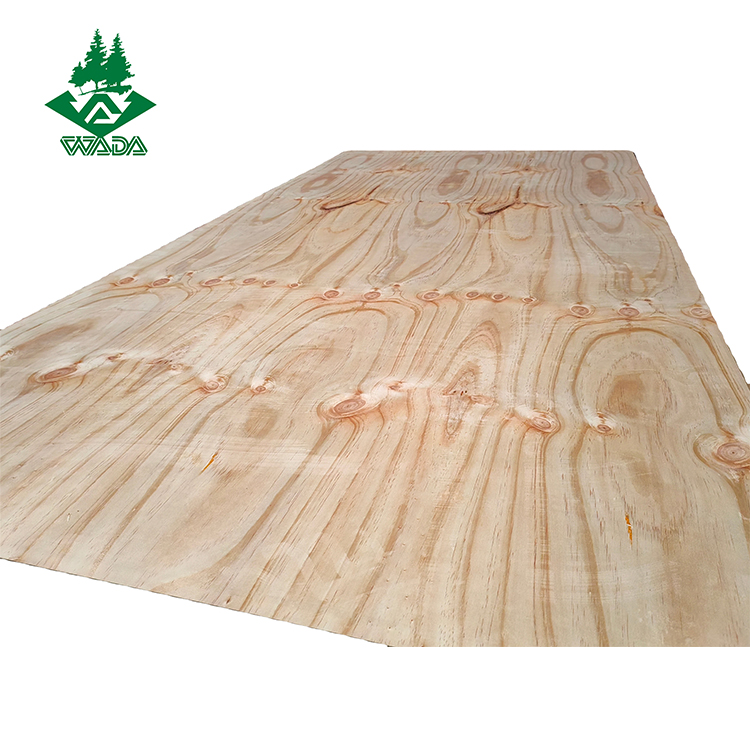
Structural plywood — selected for building structure and high-strength applications.
Wood panel comparison by project fit
The table below compares common wood panel types based on the project conditions they best serve.
| Panel type | Typical project conditions | Common applications | Key characteristics |
|---|---|---|---|
| Structure Plywood | Outdoor structural use; waterproof and high-strength requirements | Building construction, roof and floor systems, timber frame | 9–28 mm; larch or pine face; eucalyptus, larch, pine or combi core; melamine WBP or phenolic WBP glue; density 650–750 kg/m³ |
| Marine Plywood | High moisture, coastal, or outdoor exposure; UV and weather resistance | Shipbuilding, outdoor cladding, coastal construction | 9–25 mm; birch or okoume face; poplar, birch, okoume or combi core; melamine WBP or phenolic WBP glue; density 600–750 kg/m³ |
| Film Faced Plywood | Concrete formwork; repeated reuse on site | Construction, concrete engineering, precast concrete | 4–35 mm; dark brown or black film face; reusable 2–40 times in concrete projects; MR, melamine WBP or phenolic WBP glue; density 650–750 kg/m³ |
| Commercial Plywood | Furniture, interior fit-out, packaging; smooth face and stable core | Furniture, construction, packing, industrial use | 2–25 mm; birch, pine, okoume, bintangor, sapele, pencil cedar, poplar faces; core poplar or eucalyptus, combi or full birch; glue E0, CARB P2, E1, E2 or WBP |
| MDF | Continuous workshop production; smooth surface and stable core | Furniture board, routed board, lightweight high-strength board, waterproof board | 1.2–50 mm; density 500–1000 kg/m³; moisture content 5–13%; glue E0, CARB P2 or E1; certificates FSC, CARB/EPA, JIS, EUDR |
| Melamine Board | Indoor dry environment; eco-friendly and decorative finish | Furniture, cabinets, wardrobes, interior finishing | 2–30 mm; melamine paper, PET film or HPL face; core plywood, MDF, particle board or blockboard; glue E0, CARB P2, E1 or E2 |
| Veneered Board | Interior decoration; low formaldehyde, aesthetic face | Furniture, cabinets, wall panels, fancy panel work | 2–25 mm; white oak, red oak, black walnut, parota, wenge, ash, birch, pine, sapele faces; core plywood, MDF, chipboard or blockboard; glue E0, CARB P2, E1, E2 or melamine |
| LVL Bed Slat | Furniture frame and bed support; high strength in thin sections | Bed slats, bed frames, hospitality furniture | 25–190 mm width; 7–15 mm thickness; birch, beech or poplar face and birch or poplar core; glue E0 or E1 |
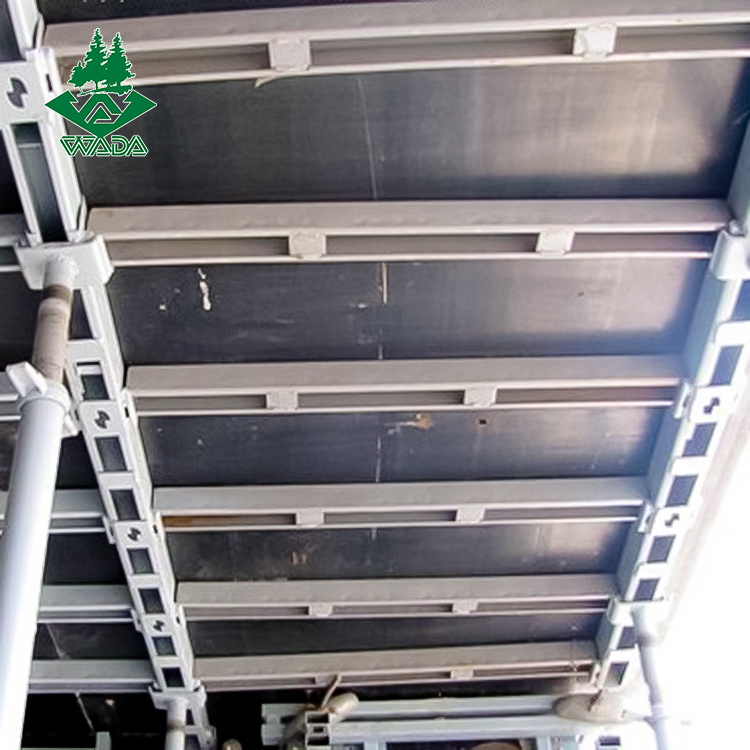
Film faced plywood — matched to concrete formwork and high-moisture construction conditions.
Indoor furniture and decoration projects often move toward melamine board, veneered board, or MDF, depending on the required surface and machining behavior.
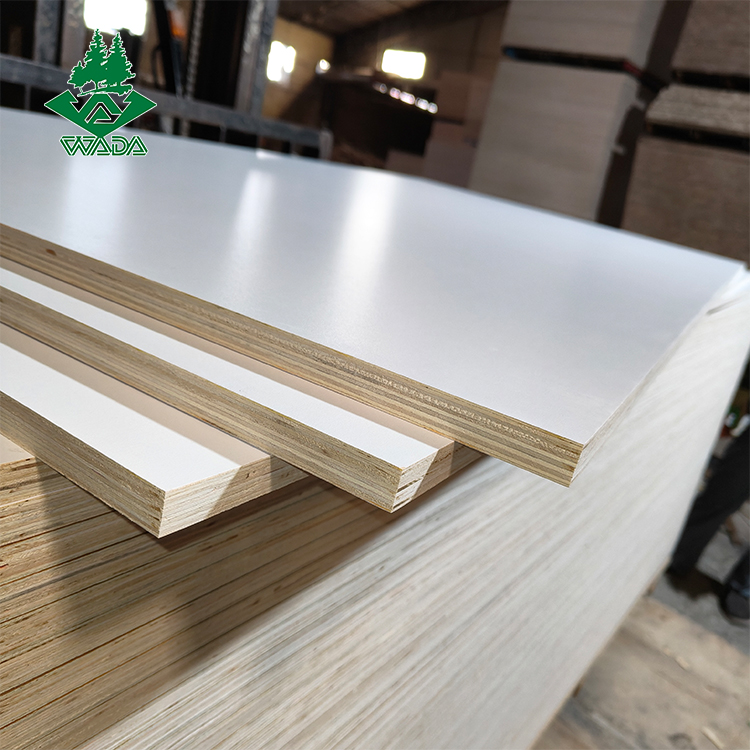
Melamine and veneered boards — for indoor furniture and decoration.
For furniture frame and bed support, LVL bed slats are a dedicated component with high strength in a thin cross-section.
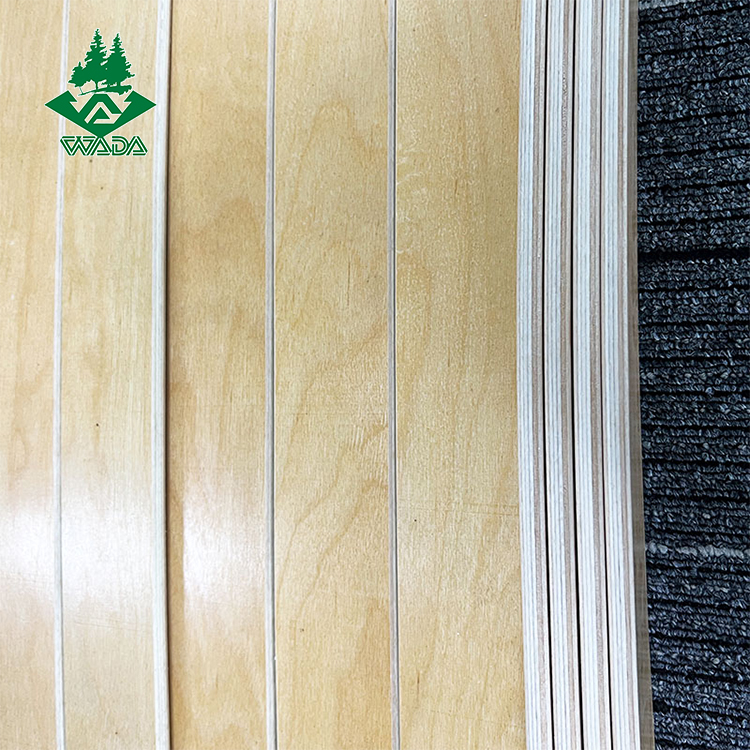
LVL bed slats — for furniture frame and bed support.
Frequently asked questions
Which environmental certifications must my project’s wood panel meet?
It depends on the destination market. Dalian WADA International Trading Co., Ltd. supplies panels with FSC, EUDR, CARB P2, EPA, JAS, and JIS certifications. For construction panels entering the European Union, compliance with the harmonized standard EN 13986 is the relevant CE marking requirement. In the United States, EPA TSCA Title VI limits formaldehyde emissions to 0.05 ppm for hardwood plywood and 0.11 ppm for MDF. Matching the panel’s glue system and certificate to the project’s market is the safest starting point.
Can Dalian WADA customize wood panel size and structure for my project?
Yes. Dalian WADA operates OEM/ODM capabilities, with customization available for size, thickness, and core layout. Production covers a wide range: MDF from 1.2 mm to 50 mm, structural plywood from 9 mm to 28 mm, film faced plywood from 4 mm to 35 mm, and commercial plywood from 2 mm to 25 mm, among others. The company’s monthly capacity for panels exceeds 10,000 CBM, with a standard MOQ of one 40-foot container.
How should I balance cost and performance when choosing a wood panel?
The main point is to match the panel to the working conditions, not to the lowest available price per sheet. For example, indoor dry environments can use E0 or CARB P2 boards with a smooth decorative face; outdoor or high-humidity projects should use panels with WBP glue systems such as marine plywood or structural plywood. When comparing options, include rework risk, compliance risk, and delivery reliability in the total cost consideration, not only the panel price.
Can I verify panel quality before placing a full container order?
Yes. The typical approach is to confirm the specification — thickness, glue system, face/back material, core structure, density, moisture content, and certificate — before production begins. Dalian WADA applies 100% inspection as part of its quality control process and provides remote after-sales support. Defining the specification clearly at the start reduces the risk of mismatched goods at shipment.
What is the lead time for a wood panel order, and how do I start?
Dalian WADA’s standard lead time is 25–45 days, with a minimum order quantity of one 40-foot container. To start, prepare the project working conditions, panel requirements, and target market compliance needs, then request a quotation. For a full overview of Dalian WADA’s product range, see the company brochure.
Conclusion: working conditions are the real specification
Wood panel names are convenient labels, but they do not replace the technical specification that a project needs. The five-condition framework — environment, function, operation mode, special requirements, and compliance — produces a sharper, more defensible selection for any project.
Dalian WADA International Trading Co., Ltd. was founded in 2010 and operates a factory area of 53,950 m² with 200 employees and a 25-person R&D team. The company reports annual output of USD 3.5–4 million, exports 100% of its production, and serves markets including North America, the EU, Australia, Japan, South Korea, the Middle East, Mexico, and South America. With FSC, EUDR, CARB P2, EPA, JAS, and JIS certifications, and export experience across more than 50 countries, Dalian WADA translates working conditions into structured wood panel specifications — and supports those specifications with standardized inspection and remote after-sales service.
If your project needs a wood panel partner that can move from site conditions to shipment, start with the requirements, not the name.
Request a quote or sample specification
Email: wada@wadatrade.com | WhatsApp: +86 131-3003-0584
Website: www.wadaplywood.com
Have Questions or Need More Details?
Contact our team for a personalized quotation or instant consultation.
Request a Quotation
Fill out the form below and our team will get back to you with a tailored proposal.
WhatsApp Direct Chat
Prefer to chat in real-time? Message us on WhatsApp for instant assistance & quick answers.
- Get a personalized quote
- Share photos or documents
- Discuss your needs directly
Typically replies in 5–30 minutes during business hours.