
Best Wood Panel Choices for Kitchen Cabinets in 2026: A Recommendation List
The short answer: the best wood panel for a kitchen cabinet in 2026 depends on which condition you are protecting against. Marine plywood ranks first where moisture is the risk, melamine board ranks first where a factory-finished decorative surface is the requirement, MDF ranks first for routed and painted doors, commercial plywood covers the general carcass, veneered board carries the premium natural face, and LVL handles engineered internal members. This is a material ranking: each position is explained by measurable panel properties and certificates, not by brand preference.

Kitchen cabinetry is one of the few furniture applications where a panel must survive steam, standing water, repeated cleaning and heat cycling while still holding a flat, decorative face and clearing the formaldehyde rules of the destination market. That is why "best" here means best for a defined cabinet condition, not best in general.
Dalian WADA International Trading Co., Ltd., trading as WADA GROUP, is an engineered wood panel manufacturer and exporter established in 2010 and based in Dalian, China. The company produces LVL, plywood, veneered board, MDF, OSB, wall panel and woodworking machinery, exports 100% of its output to North America, the EU, Australia, Japan, South Korea, the Middle East, Mexico and South America, and holds FSC, EUDR, CARB P2, EPA, JAS and JIS certification across its product lines. All specifications quoted in this list come from WADA's published product and capability data.
Why Kitchen Cabinet Panels Fail — And What That Means for Selection
Most cabinet failures are not abstract material failures. They are mismatch failures: a panel that was correct for a wardrobe and wrong for a sink base.
- Edge swelling and water uptake. The cut edge is the exposed part of any panel. In wet zones — sink bases, dishwasher surrounds, the space under a trap — the edge and the fixings are where moisture enters first.
- Delamination. Veneer layers or a laminated surface separate when the glue class does not match the exposure level. Weather-and-boil-proof glue classes exist precisely because interior glue classes do not hold under repeated moisture cycling.
- Finish and machining limits. A substrate that cannot be routed, profiled or painted cleanly caps the door design before production starts.
- Compliance failure. A cabinet that is technically sound can still be stopped at the border or rejected in a contract if the formaldehyde documentation does not match the destination market's rules.
Those four risks translate into four selection constraints that should be ranked before any panel is ordered: moisture exposure, load and fixing requirement, finish route, and compliance scope. The recommendation list below is organised around those four constraints.
Industry Background: A 2026 Snapshot of the Panel Market
The panel categories used in kitchens sit inside a large and still-growing materials market. Plywood, the category that anchors most cabinet carcasses, was valued at USD 80.57 billion globally in 2025, with Asia Pacific holding the largest revenue share at 39.4% (Grand View Research). MDF, the substrate behind most routed and painted doors, is projected to grow from USD 44.96 billion in 2025 to USD 82.24 billion by 2033, a compound annual growth rate of 8.2% (Grand View Research).
Adjacent categories move on different logic. Oriented strand board is a structural panel family: global OSB production reached over 32 million cubic meters in 2024, with the United States accounting for 14 million cubic meters (Market Reports World). Wood plastic composite, used in exterior and wet-area trim rather than cabinet interiors, reached USD 8.89 billion in 2025 and is expected to grow at 11.7% annually to 2033 (Grand View Research).
Regulation is moving at the same pace. According to the European Panel Federation, wood-based panels used in construction must comply with the harmonized European standard EN 13986 to be eligible for CE marking. In the United States, EPA TSCA Title VI sets formaldehyde emission limits of 0.11 ppm for MDF and 0.05 ppm for hardwood plywood, with California's CARB Phase 2 running alongside it. On the supply side, West Fraser Timber, Arauco, Kronospan and EGGER Group are recognised as the leading global producers in the wood-based panel market (Global Market Insights), while China remained the second-largest exporter of raw timber under HS 44 to the United States in 2024 at USD 2.17 billion, a 9% share (ITC / US Census Bureau).
One caution on market numbers: published valuations for the same panel category differ between research houses — one firm puts the global plywood market at USD 80.57 billion for 2025 while another places it at USD 52.5 billion. Treat headline market size as directional and verify it against the specific sub-category you are buying.
The 2026 Recommendation List: Six Wood Panel Choices for Kitchen Cabinets
Marine Plywood — the first choice for wet zones
WADA's marine plywood is supplied in 4 × 8 to 4 × 9 ft formats, 9–25 mm thick, with birch or okoume faces and a poplar, birch, okoume or combi core plywood. Glue options are melamine WBP and phenolic WBP — weather-and-boil-proof classes — with a density of 600–750 kg/m³ and moisture content of 8%–12%.
Why it ranks first. The sink base, the dishwasher surround and any run against an external wet wall are the highest-risk positions in a kitchen, and marine plywood is the panel class WADA lists specifically for high-moisture interior applications and for bathroom and kitchen manufacturing, alongside shipbuilding and coastal construction. The glue class, not the species, carries that rating.
Where it fits. Sink and hob bases, wet-zone carcasses, service voids, and any cabinet where a plumbing leak is a realistic event.
What to weigh. Marine plywood is a moisture and structural decision, not a decorative one. If the face will be visible, plan a separate decorative surface — melamine, HPL or real veneer — rather than treating the plywood face as the finished look.
Melamine Board — the first choice for a finished surface
WADA's melamine board runs from 4 × 8 to 7 × 9 ft, 2–30 mm thick, with a face and back of melamine paper, PET film or HPL over a plywood, MDF, particle board (PB) or blockboard (BB) core. Glue options are E0, CARB P2, E1 and E2; the board is supplied as furniture grade / cabinet grade with a density of 550–750 kg/m³ and moisture content of 8%–12%.
Why it ranks second. The decorative surface arrives already on the panel. There is no secondary lamination step between the panel and the visible cabinet face, which is what makes melamine the default choice for doors, drawer fronts and visible carcass surfaces in cost-controlled programmes.
Where it fits. Cabinet doors, drawer fronts, exposed side panels, shelving, and interior surfaces where a consistent clean finish matters more than a natural grain.
What to weigh. The surface is only half of the specification. Because the core can be plywood, MDF, particle board or blockboard, two boards with identical melamine faces can behave very differently at a wet cut edge. Fix the core and the glue class at the same time as the decor, not afterwards.
Veneered Board (Veneered Plywood) — the premium natural face
WADA's veneered board is supplied in 4 × 8 to 7 × 9 ft formats, 2–25 mm thick, with faces and backs in white oak, red oak, black walnut, parota, wenge, ash, birch, pine, sapeli or engineered veneer, over a plywood, MDF, chipboard or blockboard core. Veneer cut type is Q/C or C/C; glue options are E0, CARB P2, E1, E2 and melamine; grades run A, AA and AAA, with density of 500–750 kg/m³ and moisture content of 8%–12%.
Why it ranks third. Where melamine standardises the look, veneered board differentiates it. The A / AA / AAA grading system gives cabinet makers a defined way to specify how uniform the natural face must be — which is the single question that decides whether a veneered kitchen looks deliberate or inconsistent.
Where it fits. Premium door fronts, island facades, handleless fronts, and any surface where the grain is the design.
What to weigh. Veneer is a natural material, so grade and cut type must be agreed in writing before production. Buyers who need grain consistency across a large run should specify both explicitly.
MDF — the first choice for routed and painted doors
WADA's MDF is produced in 4 × 8 to 8 × 16 ft formats, 1.2–50 mm thick, on continuous flat pressing equipment from Difenbach & Sinbelkamp (Germany), with E0, CARB P2 or E1 glue, a density range of 500–1000 kg/m³ and moisture content of 5%–13%. The published usage list covers furniture board, routed board, lightweight high-strength board and water-proof board, and the specification carries FSC, CARB/EPA, JIS and EUDR certification.
Why it ranks fourth. MDF is the substrate that shaped and profiled cabinet doors are built around — its published usage list names routed board directly — and the wide density range gives cabinet makers room to choose between a lighter board and a denser, more dimensionally stable one.
Where it fits. Shaker and profile-routed doors, painted fronts, shaped panels and decorative elements.
What to weigh. MDF is not a single product. A 1.2 mm and a 50 mm board, or a standard board and a water-proof board, are different purchase decisions even though they share a category name. Specify thickness, density and the moisture variant you need.
Commercial Plywood — the general carcass workhorse
WADA's commercial plywood is supplied in 4 × 8 ft or to requirement, 2–25 mm thick, with faces and backs in birch, pine, okoume, bintangor, sapeli, pencil cedar or poplar, veneer grades from B/BB through BB/CP, BB/C and CP/CP to C/C, and a poplar, eucalyptus, combi or full birch core. Glue options are E0, CARB P2, E1, E2 and WBP; the board is graded for furniture, construction, packing and industry use, with density of 520–700 kg/m³ and moisture content of 8%–12%.
Why it ranks fifth. The veneer grading system is the practical advantage. A cabinet programme can specify B/BB faces where the surface is visible and C/C where it is not, keeping cost aligned with what the end customer will actually see.
Where it fits. Carcasses, shelves, dividers, drawer boxes and internal fit-out.
What to weigh. Commercial plywood is not a wet-zone answer by default. WBP glue is available, but where the environment is genuinely wet, marine plywood is the correct category.
LVL — the engineered member behind the face
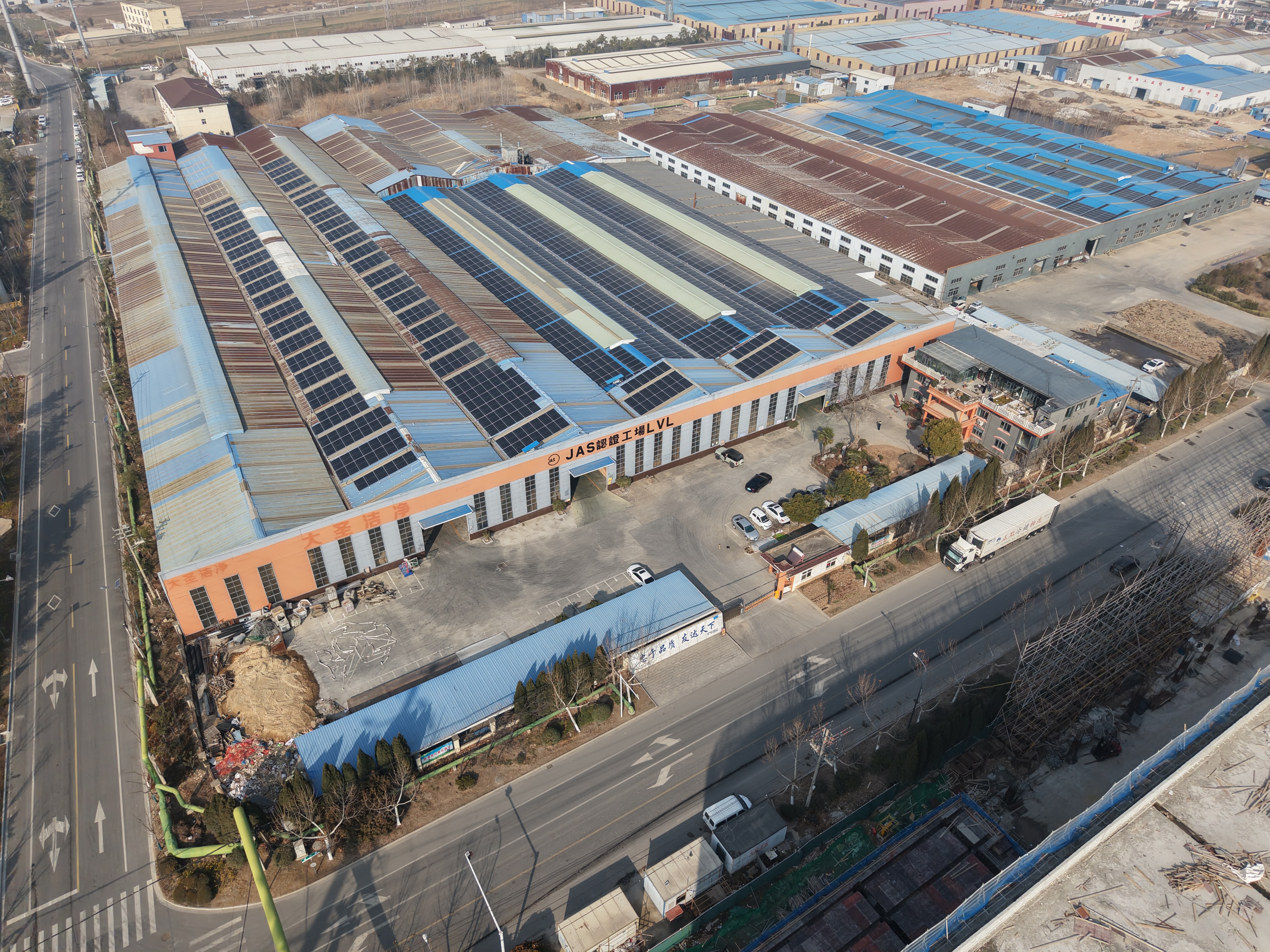
WADA's LVL line is a furniture-grade laminated veneer lumber, supplied at 25–190 mm width and 7–15 mm thickness, with birch, beech or poplar faces and a birch or poplar core, E0 or E1 glue and a stated density of 520 kg/m³. Its reference application is bed slats, and the line holds JAS certification to JAS 0701:2023 as well as BSI product certification to AS/NZS 4357.0:2005 for structural laminated veneer lumber.
Why it ranks sixth and last. LVL is not a cabinet face panel and this list does not pretend otherwise. It earns a place because a kitchen programme occasionally needs a straight, engineered member — a frame or a rail — where a flat decorative panel cannot do the job.
Where it fits. Internal frames and engineered members in furniture manufacturing, where a certified engineered section is specified.
What to weigh. Specify it as an engineered component with a defined certification requirement, not as a general-purpose board substitute.
Panels that are not kitchen cabinet panels: several panel types are routinely quoted alongside cabinet panels but belong to different categories. Film faced plywood is a formwork product — WADA's 17 mm formwork plywood holds a StandardsMark licence under AS 6669-2016 and is rated for 2–40 uses in concrete projects. OSB and FOSB are structural panel categories, with global OSB production above 32 million cubic meters in 2024. Exterior wall cladding and engineered or laminate flooring are separate finishing categories, covered within the FSC chain-of-custody scope of WADA's certification. None of these should be specified as a kitchen cabinet interior or face panel.
Step-by-Step: How to Choose a Kitchen Cabinet Panel in Six Decisions
- Split the cabinet run into wet zones and dry zones. Sink base, dishwasher surround, plumbing access and external wet walls are wet-zone; everything else is dry-zone. Assign different panel classes to each rather than specifying one board for the whole kitchen.
- Fix the core before the face. Core options across WADA's lines include plywood, MDF, particle board, blockboard, poplar, eucalyptus, birch, combi and full birch constructions. The core sets moisture behaviour and fixing strength; the face only sets the look.
- Match the glue class to the exposure. Available glue systems include MR, E2, E1, E0, CARB P2, melamine WBP and phenolic WBP. Wet zones need a WBP class; dry interiors can be served by E0 or CARB P2 grades.
- Choose the finish route. Melamine paper, PET film or HPL for a factory-finished surface; real veneer in white oak, red oak, black walnut, ash, birch, pine, sapeli or engineered veneer for a natural face; bare MDF for routed and painted doors.
- Check the certification against the destination market. EN 13986 for CE marking in the EU, EPA TSCA Title VI and CARB Phase 2 for the United States, JIS and JAS for Japan, AS and AS/NZS standards for Australia and New Zealand, and FSC chain of custody where it is a purchasing requirement.
- Validate and lock the specification sheet before the order. Confirm thickness, density range, moisture content, face grade, glue class and certification scope in writing, then check the physical panel against that document.
How These Panel Classes Have Performed in Real Programmes
WADA's delivered programmes show the same matching logic at container scale.
- Mexico — furniture and cabinet decoration (North America). A furniture manufacturing client ran 100 containers of product for furniture and cabinet decoration purposes. The recorded result was decoration quality, with fashion in decoration as the programme highlight. This is the closest published reference to a cabinetry-style brief: visible surfaces, repeat volume, finish-driven specification.
- Vietnam — plywood production line (Southeast Asia). A plywood manufacturer client took a complete line used to manufacture plywood, veneer and engineered wood panels for furniture, construction, packaging and interior applications. The recorded result was stable production under a one-stop solution model.
- Portugal — outdoor cladding (EU). A wall cladding client ran 20 containers for outdoor cladding, with a weather-resistant result and UV resistance as the key highlight. It is useful here as a contrast case: cladding performance is driven by weather and UV exposure, a different requirement set from interior cabinetry, even though both are wood panels.
- Japan and Australia — building structure (Asia and Oceania). A construction builder and a building contractor ran 200 containers and 50 containers respectively for building structure applications, with high strength, high durability and waterproof properties as the recorded highlights. These programmes confirm how much panel performance is decided by glue class and core build-up rather than by the panel's name.
Comparison Table: The Six Recommended Panels Side by Side
| Rank | Panel | Face / Back | Core / Build-up | Glue options | Thickness | Density | Best kitchen position |
|---|---|---|---|---|---|---|---|
| 1 | Marine Plywood | Birch / Okoume | Poplar, birch, okoume or combi core plywood | Melamine WBP / Phenolic WBP | 9–25 mm | 600–750 kg/m³ | Sink base, dishwasher surround, wet-zone carcass |
| 2 | Melamine Board | Melamine paper / PET film / HPL | Plywood, MDF, particle board (PB), blockboard (BB) | E0 / CARB P2 / E1 / E2 | 2–30 mm | 550–750 kg/m³ | Doors, drawer fronts, visible panels |
| 3 | Veneered Board (Veneered Plywood) | White oak, red oak, black walnut, parota, wenge, ash, birch, pine, sapeli, engineered veneer | Plywood, MDF, chipboard, blockboard (BB) | E0 / CARB P2 / E1 / E2 / melamine | 2–25 mm | 500–750 kg/m³ | Premium facades, island fronts |
| 4 | MDF | Wood fibre (routed / painted) | Wood fibre, continuous flat pressing | E0 / CARB P2 / E1 | 1.2–50 mm | 500–1000 kg/m³ | Routed and painted door fronts |
| 5 | Commercial Plywood | Birch, pine, okoume, bintangor, sapeli, pencil cedar, poplar | Poplar / eucalyptus, combi or full birch | E0 / CARB P2 / E1 / E2 / WBP | 2–25 mm | 520–700 kg/m³ | General carcass, shelves, dividers |
| 6 | LVL (furniture grade) | Birch / beech / poplar | Birch / poplar veneer | E0 / E1 | 7–15 mm | 520 kg/m³ | Internal frames and engineered members |
All thickness, density, glue and face values above come from WADA's published product specifications. Where a project needs a value outside those ranges, treat it as a customization request and confirm it in writing before quoting.
Certification Map by Panel Line
| Panel line | Certification held (as published) | Market relevance |
|---|---|---|
| Plywood — structure and special type structural | JAS to JAS 0233:2024; CARB Phase 2 + EPA against TSCA Title VI and California Code of Regulations 93120–93120.12 for hardwood plywood (HWPW-VC) | Japan; United States and California |
| Plywood — 17 mm formwork | StandardsMark licence to AS 6669-2016 (Plywood — Formwork) | Australia, New Zealand |
| MDF | JIS MARK certification to JIS A 5905 (Fiberboards); FSC, CARB/EPA, JIS and EUDR listed in the specification | Japan; EU; North America |
| LVL | JAS to JAS 0701:2023; BSI product certification to AS/NZS 4357.0:2005 (structural LVL) | Japan; Australia, New Zealand |
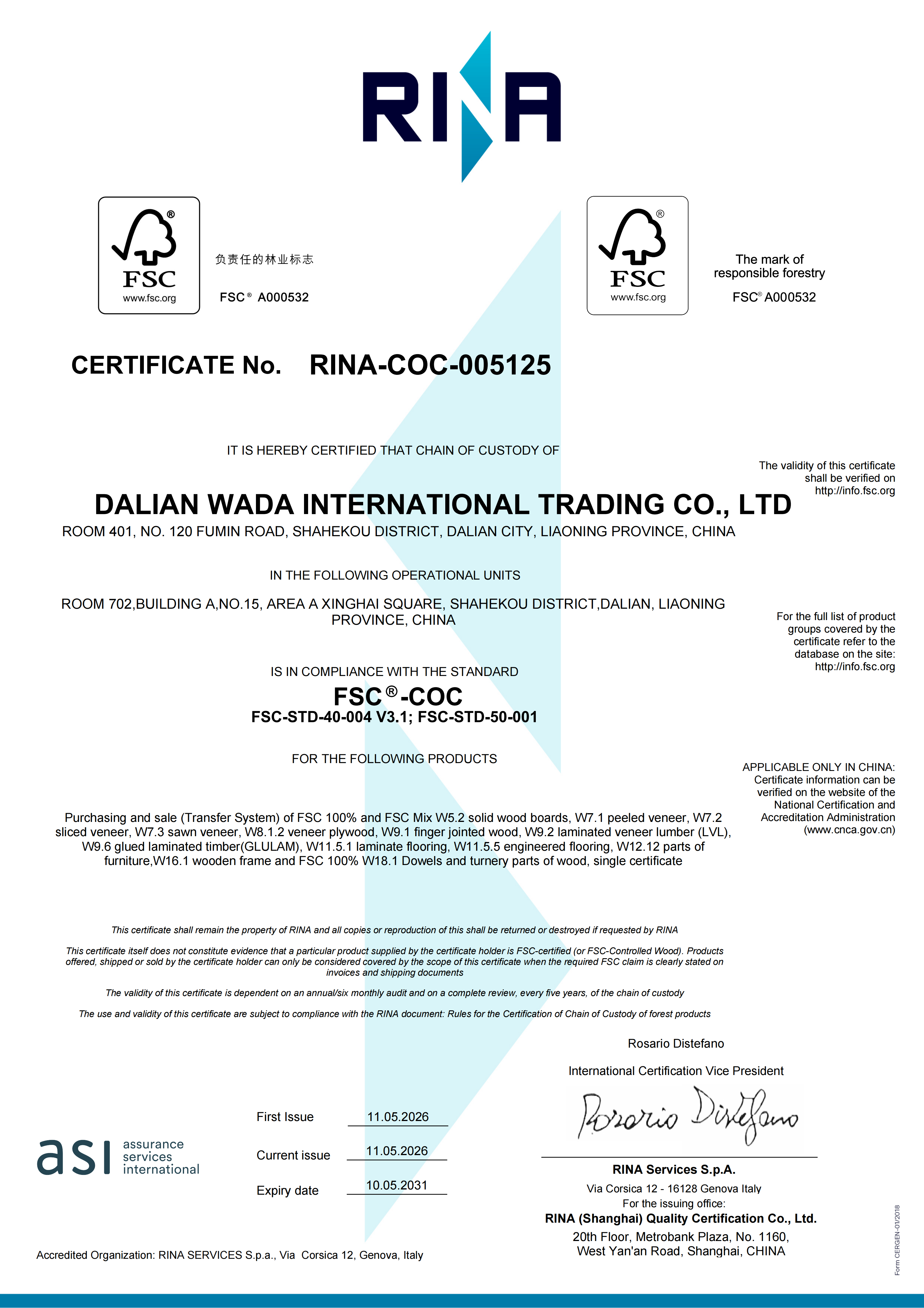
| Veneered board, solid wood boards, veneers, laminate and engineered flooring, furniture parts, wooden frames | FSC chain-of-custody scope includes these product groups | EU, North America, UK |
| Melamine board | Specification lists E0 / CARB P2 / E1 / E2 glue options | Confirm certificate scope per project |

Frequently Asked Questions
Which certifications should a kitchen cabinet panel carry for the EU, the US and Japan?
Three markets set three different bars. For the EU, wood-based panels used in construction must comply with the harmonized European standard EN 13986 to be eligible for CE marking, according to the European Panel Federation. For the United States, EPA TSCA Title VI sets formaldehyde emission limits of 0.11 ppm for MDF and 0.05 ppm for hardwood plywood, and WADA holds CARB Phase 2 + EPA certification against TSCA Title VI and California Code of Regulations sections 93120–93120.12 for hardwood plywood. For Japan, WADA holds JIS MARK certification to JIS A 5905 for fiberboard (MDF), JAS certification to JAS 0233:2024 for plywood and special type structural plywood, and JAS 0701:2023 for LVL. Where chain of custody is a purchasing requirement, FSC covers solid wood boards, veneers, veneer plywood, LVL, glulam, laminate and engineered flooring, furniture parts and wooden frames.
Can panel size, thickness and surface be customized for a cabinet programme?
Yes. WADA runs OEM and ODM programmes with customization across size, thickness and layout, and a monthly panel capacity of more than 10,000 CBM. The published ranges set the working envelope: MDF from 4 × 8 to 8 × 16 ft and 1.2–50 mm thick; melamine board from 4 × 8 to 7 × 9 ft and 2–30 mm; veneered board from 4 × 8 to 7 × 9 ft and 2–25 mm; commercial plywood from 2–25 mm; marine plywood from 9–25 mm; film faced plywood from 4–35 mm. Surface routes include melamine paper, PET film, HPL and natural or engineered veneer. The OEM/ODM programme currently serves South America, the EU, the Middle East and Southeast Asia, and every shipment is subject to 100% inspection.
What drives the cost of a kitchen cabinet panel?
WADA does not publish list prices, because panel cost is set by the specification decisions described in this article. The variables that move cost are the core type (plywood, MDF, particle board or blockboard), the glue class (E2 through E0, CARB P2, or melamine and phenolic WBP), thickness and panel format, the surface route (melamine paper, PET film, HPL or natural veneer), the face grade (A, AA or AAA on veneered board; B/BB through C/C on commercial plywood), the certification scope the destination market requires, and order volume against the 1 × 40' container minimum order quantity. The practical sequence is to fix the specification first and then request a quotation against it — that is what makes two quotes comparable.
How do buyers validate a panel before committing to a production order?
Validation follows the same sequence in most cabinet programmes: confirm the specification sheet, then check the panel physically against it — face grade and consistency, thickness, moisture content, and how the cut edge behaves — before releasing volume. WADA's team supports sample and specification confirmation, and the fastest route is a direct inquiry to wada@wadatrade.com or WhatsApp +86 131-3003-0584 with the panel class, format, thickness, glue class and destination market you are working to.
What are the minimum order quantity and lead time?
The published commercial terms are a minimum order quantity of 1 × 40' container and a lead time of 25–45 days, against a monthly panel capacity of more than 10,000 CBM and remote after-sales support. Lead time should always be checked against the specific panel class, because a customized veneered board run and a standard MDF run do not carry the same production sequence. To start, request the WADA Group catalogue and specification pack, then send your cabinet programme requirements for a quotation.

Conclusion: Pick the Panel by Condition, Not by Category Name
The 2026 recommendation list for kitchen cabinets comes down to six positions. Marine plywood first, because wet zones are where cabinets fail and WBP glue classes are the answer. Melamine board second, because a factory-finished decorative surface removes a production step. Veneered board third, for grain-driven premium work. MDF fourth, for routed and painted doors. Commercial plywood fifth, as the graded carcass panel that keeps cost aligned with visibility. LVL sixth, as the engineered member that sits behind the face.
Two habits separate a well-run cabinet programme from an expensive one. First, split the kitchen into wet and dry zones and specify them separately — a single board for the whole kitchen almost always means paying for performance where it is not needed, or missing it where it is. Second, lock the specification sheet, covering core, glue, thickness, density, moisture content, face grade and certification scope, before the first container is booked, because those are the parameters that decide whether the cabinets still look right in year five.
Planning a 2026 kitchen cabinet programme?
WADA GROUP supplies marine plywood, melamine board, veneered board, MDF, commercial plywood and LVL from China to North America, the EU, Australia, Japan, South Korea, the Middle East, Mexico and South America, with OEM/ODM customization, 100% inspection and certification to FSC, CARB P2, EPA, JAS and JIS.
Email wada@wadatrade.comWhatsApp +86 131-3003-0584Download the WADA Group catalogue (PDF)
Have Questions or Need More Details?
Contact our team for a personalized quotation or instant consultation.
Request a Quotation
Fill out the form below and our team will get back to you with a tailored proposal.
WhatsApp Direct Chat
Prefer to chat in real-time? Message us on WhatsApp for instant assistance & quick answers.
- Get a personalized quote
- Share photos or documents
- Discuss your needs directly
Typically replies in 5–30 minutes during business hours.