
How Supplier Capability Verification Protects Wood Panel Delivery Timelines
Scope: importers, distributors, furniture and cabinet manufacturers, and procurement teams sourcing plywood, MDF, LVL, veneered board, or melamine board.
A wood panel order rarely misses its delivery date because the contract forgot to name one. It misses because the capacity, inspection structure, and raw material base behind that date were assumed rather than verified. Capability verification is the stage at which a wood panel delivery timeline is either protected or quietly compromised, and it happens before the purchase order is signed, not after the first delay notice arrives.
Dalian WADA International Trading Co., Ltd. is a manufacturer and global exporter of engineered wood products, including plywood, MDF, LVL, veneered board, and melamine board, established in 2010 and exporting to North America, the EU, Australia, Japan, South Korea, the Middle East, Mexico, and South America. The verification criteria used throughout this article are the same capability facts WADA publishes to buyers: monthly panel capacity, standard production lead time, minimum order quantity, inspection depth, and after-sales support.
Problem Definition: Where Wood Panel Delivery Timelines Actually Break
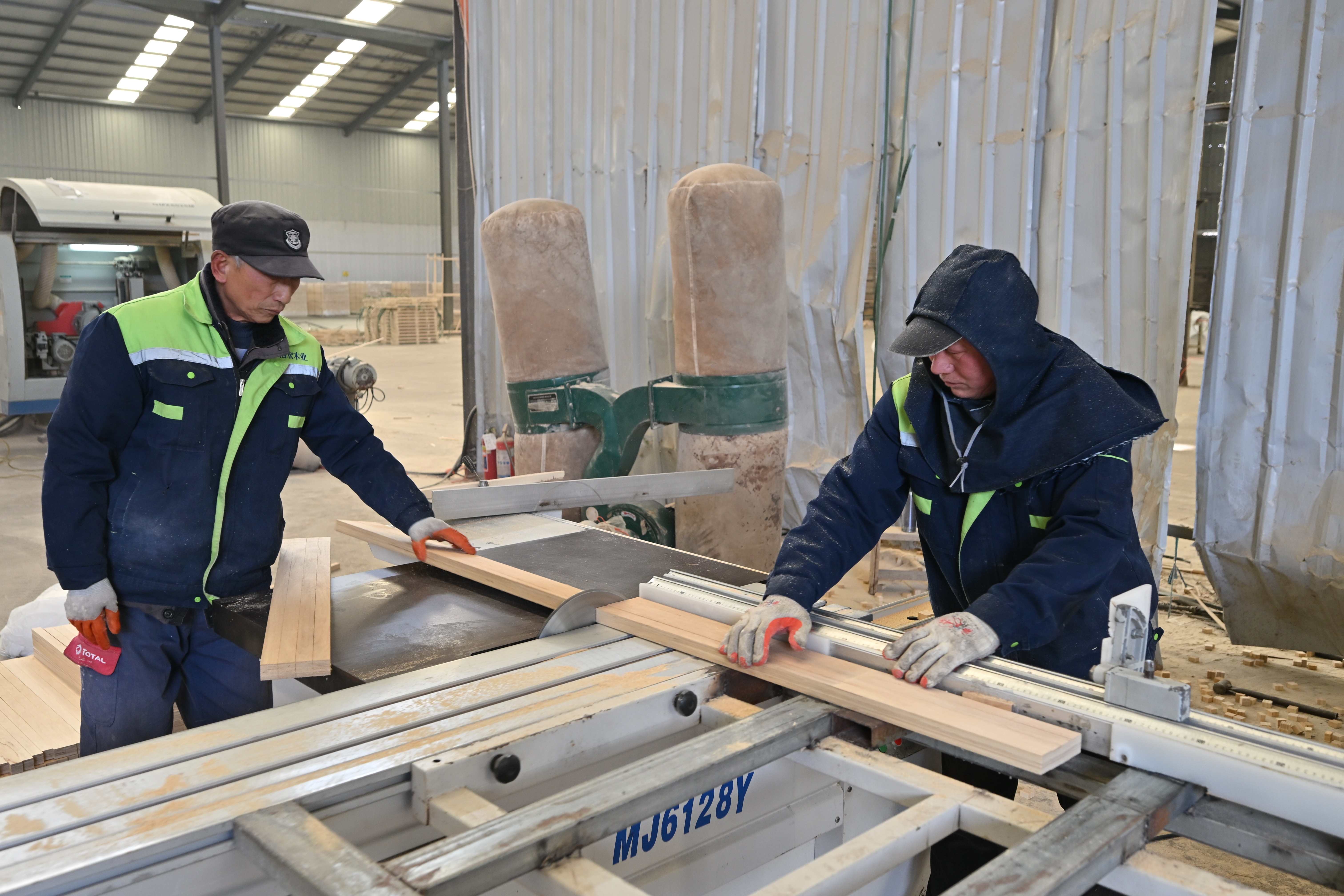
A delivery timeline is a production commitment, not a shipping promise. It holds only when four conditions are true at the same time: the supplier has unbooked capacity for your volume, the specification is fixed and producible, the inspection stage clears the panels instead of pushing them into rework, and the raw material (veneer, film, glue, fiber, or melamine paper) is on hand when the line is scheduled.
When one of those conditions fails, the delay rarely shows up as a capacity problem. It shows up as an unanswered email, a pushed-back vessel booking, or a container held at the loading point. Four failure modes account for most of these situations:
- Capacity overcommitment. The supplier accepts an order that overlaps with peak production for other customers. No contract clause is breached; the schedule simply cannot absorb both volumes.
- Specification drift before production. Size, thickness, or layout is agreed verbally and confirmed late. Because a minimum order quantity of 1x40' container is the standard entry point in this category, a late specification change is not a small correction: it resets the production plan for a full container.
- Inspection-driven rework. Panels that fail a late inspection stage consume the buffer that protected the delivery date. Inspection depth is therefore a scheduling variable, not only a quality variable.
- Raw material gaps. Veneer grades, film, glue type, and melamine paper are all inputs with their own supply cycles. A supplier that has not secured them before the line is scheduled will move the completion date.
Boundary condition: capability verification reduces delivery risk; it does not delete it. Ocean freight schedules, port congestion, customs and quarantine inspection, and force majeure sit outside any supplier's control. What verification does is remove the portion of the risk that the supplier creates and controls, which in most delayed orders is the larger share.
Industry Background: Why Capacity Discipline Matters More Than Ever
Wood panel demand has been expanding across categories, which raises the commercial value of confirmed, unbooked capacity. The global plywood market was valued at USD 80.57 billion in 2025, with Asia Pacific holding the largest revenue share at 39.4%, according to Grand View Research. Grand View Research also projects the global MDF market to grow from USD 44.96 billion in 2025 to USD 82.24 billion by 2033, a CAGR of 8.2%. In OSB, global production reached over 32 million cubic meters in 2024, of which the United States accounted for 14 million cubic meters, per Market Reports World. Wood plastic composites, an adjacent category, reached USD 8.89 billion in 2025 with an expected CAGR of 11.7% through 2033 (Grand View Research).
Panel supply is also structurally mixed. Large international producers such as West Fraser, Arauco, Kronospan, and EGGER Group are identified as leaders in the wood-based panel market by Global Market Insights, while specialist exporters and integrated manufacturers serve the customized and mid-volume programs that most importers actually buy. Sourcing context matters as well: China was the second largest exporter of raw timber (HS 44) to the United States in 2024, contributing USD 2.17 billion, or a 9% share, according to ITC / US Census Bureau data published through TradeMap.
Compliance adds a second schedule variable. Wood-based panels used in construction must comply with the harmonized European standard EN 13986 to be eligible for CE marking, per the European Panel Federation. In the United States, the EPA TSCA Title VI regulation sets formaldehyde emission limits of 0.11 ppm for MDF and 0.05 ppm for hardwood plywood. A certificate problem or a failed emission test does not delay production by a day; it delays a shipment by a full documentation and retest cycle. That is why compliance verification belongs inside the delivery-timeline discussion rather than in a separate folder.
Detailed Solution: Five Capability Layers That Protect a Delivery Date
Capability verification works when each layer is checked against a number, a document, or a written statement instead of a supplier's general reputation. The five layers below apply to any wood panel supplier; the reference values are the ones WADA states for its own panel programs.
Layer 1 — Monthly capacity measured in CBM, not in assurances
The verifiable statement is monthly panel capacity: 10,000+ CBM for WADA's panel production. Buyers should convert their own program into the same unit and then ask one specific question: how much of that capacity is already booked in the month our order would run? A capacity figure is only useful for scheduling when it is compared against remaining, unbooked volume.

Layer 2 — A lead time window with a defined starting point
Standard production lead time is 25 to 45 days. The number only becomes a planning tool once the trigger is fixed. Buyers should confirm in writing what starts the clock: order confirmation, deposit receipt, or specification sign-off. The difference between those three starting points is exactly where timelines are lost. Once the trigger is agreed, the 25 to 45 day window becomes a trackable date rather than a range that can be reinterpreted later.
Layer 3 — Order structure: MOQ, shipping basis, and payment terms
The minimum order quantity is 1x40' container. Delivery is quoted FOB or CIF, and payment terms are T/T 30/70 or 50/50. All three affect schedule behaviour. A container-sized MOQ means the first verifiable shipment is also the first significant financial commitment, so verification passes should be completed before that order is released. Because partial-load consolidation is not part of this order structure, buyers should plan volumes to fit a full container rather than expect flexibility to appear later.
Layer 4 — Inspection depth as a schedule control
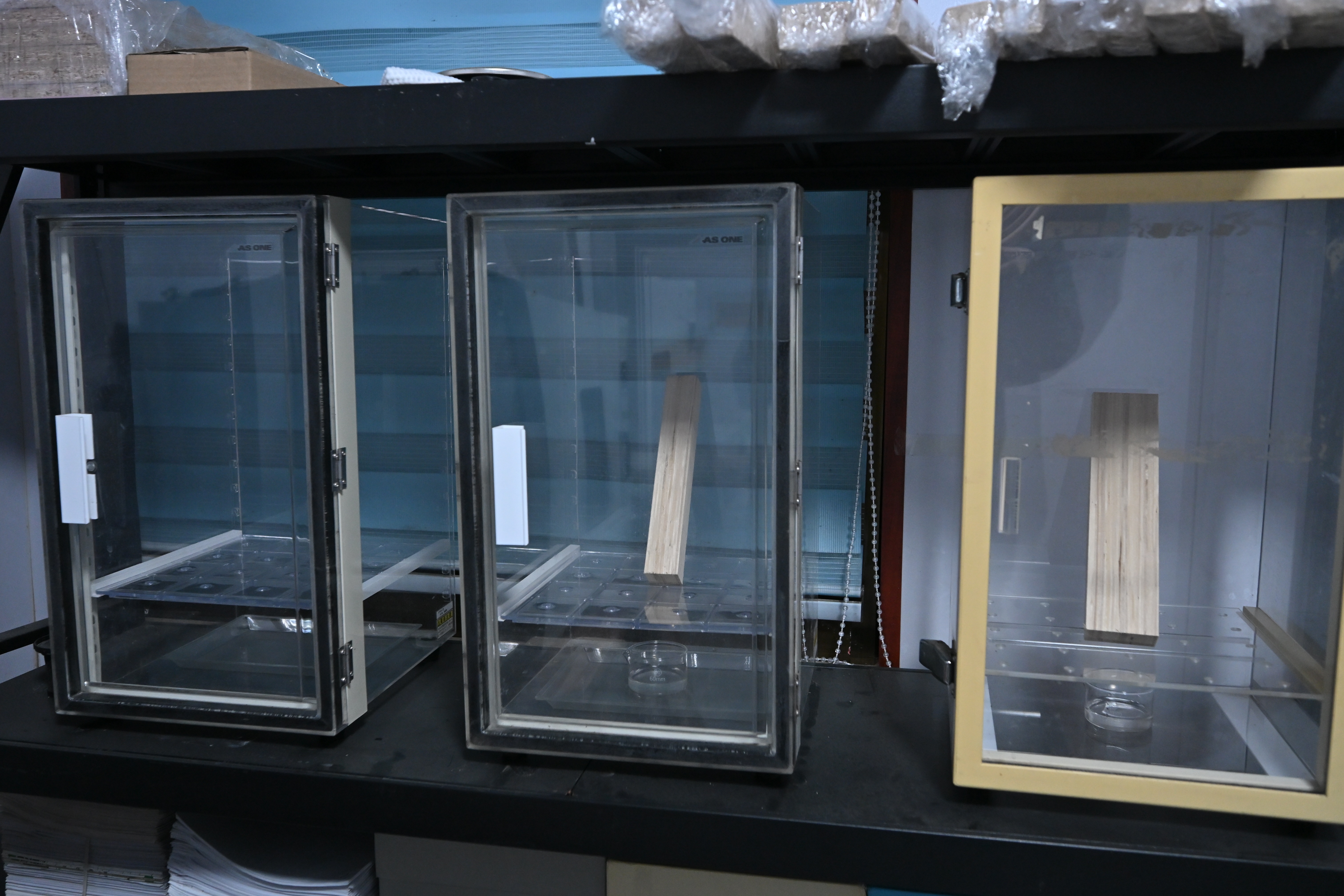
Quality control includes 100% inspection, and acceptance is based on a pre-shipment test. Panel-level inspection is what prevents a defect from being discovered at destination, where the cost is not a rework slot but a full container cycle. This is the layer buyers should document most carefully: which stages are inspected, what the pass criteria are, and who signs off before the container is released. Certification scope belongs here too, because certificates are verified before shipment, not after arrival.
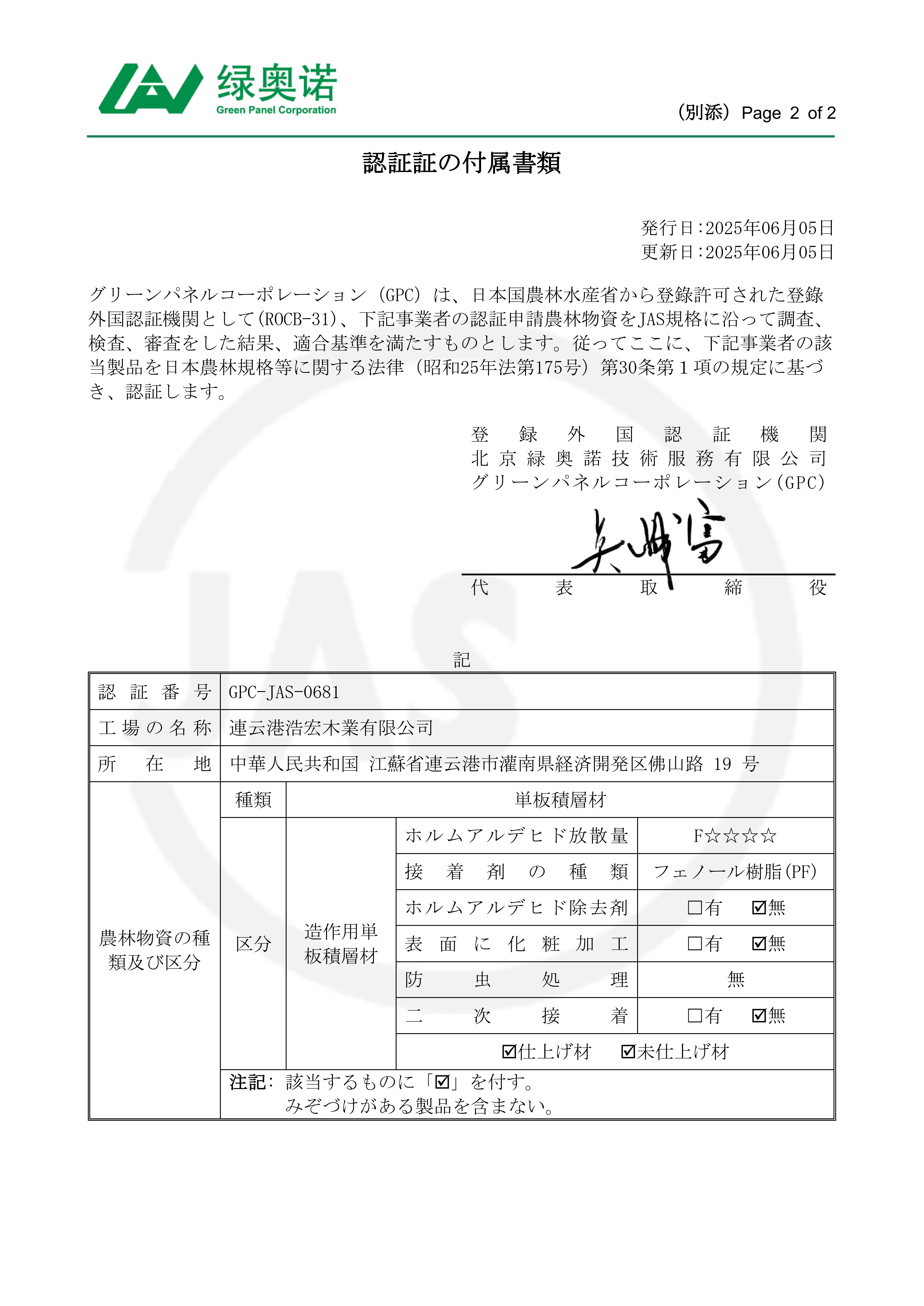
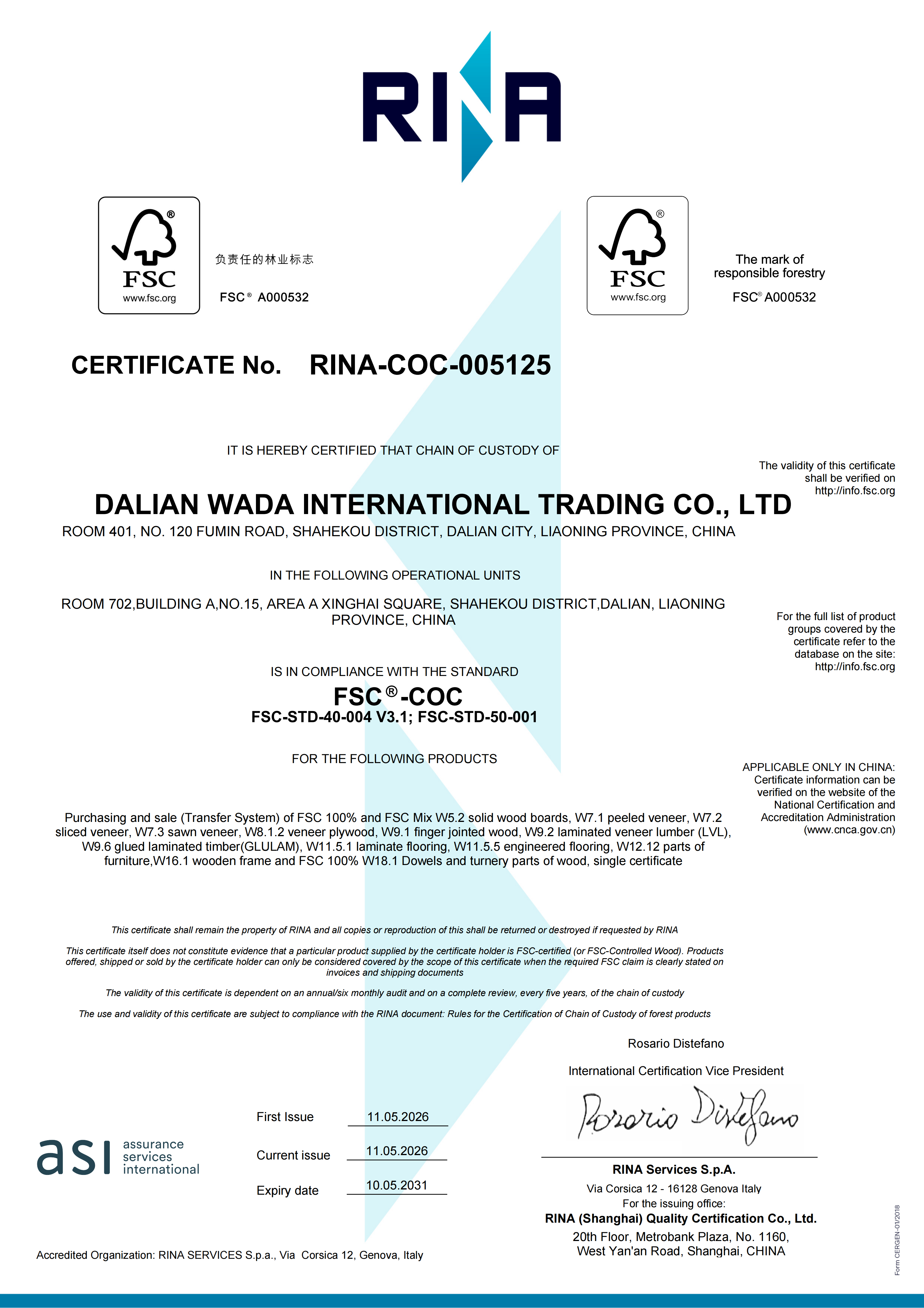
Certification coverage for WADA's engineered wood products includes FSC and EUDR for environmental and due-diligence requirements, CARB P2 and EPA for the North American formaldehyde framework, and JAS and JIS for the Japanese market. The FSC scope covers solid wood boards, peeled, sliced and sawn veneer, veneer plywood, finger-jointed wood, LVL, GLULAM, laminate flooring, engineered flooring, furniture parts, wooden frames, and dowels and turnery parts. Product-specific approvals include JAS 0701:2023 for laminated veneer lumber, JAS 0233:2024 for plywood and special-type structural plywood, JIS A 5905 for MDF, JIS A 5908 for particle board, AS/NZS 4357.0:2005 for structural LVL in Australia and New Zealand, AS 6669-2016 for 17 mm formwork plywood, and CARB Phase 2 with TSCA Title VI for hardwood plywood.
Layer 5 — Raw material base and after-sales support
Production capacity is only as reliable as the material feeding it. WADA operates with integrated production bases in China, domestic trading companies, and overseas branches in Japan and Singapore, a structure intended to keep material flow and order flow connected rather than separately managed. The company states long-term cooperative partnerships across more than 50 countries, with 100% of output exported, and remote support as its after-sales service.
Remote after-sales support matters at the execution stage because most post-shipment timeline risks are documentation and specification issues rather than construction defects: a packing list that does not match loading order, a label query, or a claim that needs the shipment record. A supplier that resolves these remotely shortens the response cycle; one that cannot adds calendar days to every open item.
Step-by-Step Breakdown: A Verification Sequence to Run Before Signing
- Convert your program into capacity units. Express expected annual and peak monthly volume in CBM. Ask the supplier for monthly panel capacity (WADA states 10,000+ CBM) and for the unbooked share during your target production month.
- Fix the lead time trigger. Record the standard lead time (25 to 45 days) and the event that starts it. Put both into the order confirmation.
- Check order structure against your volume. Confirm the MOQ (1x40' container), the shipping basis (FOB or CIF), and payment terms (T/T 30/70 or 50/50) before specification work begins.
- Map the inspection stages. Request the QC structure, confirm that 100% inspection applies, and identify the pre-shipment test as the formal acceptance gate.
- Match certification scope to the destination market. Compare the certificate list (FSC, EUDR, CARB P2, EPA, JAS, JIS, and the product-specific standards listed earlier) with your import requirements, and add EN 13986 for EU construction use.
- Agree the after-sales protocol. Confirm how remote support handles specification queries, packing matters, and claims, and who the named contact is on the supplier side.
Checklist to keep on file: capacity figure and unbooked volume; lead time window and its trigger; MOQ and shipping basis; inspection stages and acceptance test; certificate scope by market; after-sales contact and response route.
Use Cases: What Verified Capability Looks Like in Real Programs
Verified capability tends to show up in programs where order structure, category mix, and production discipline had to align at the same time.
- Mexico — 100 containers for furniture and cabinet decoration. A furniture manufacturer program combined melamine board, veneered board, LVL, and MDF across 100 containers, achieving decoration results with fashion as the highlight. For the buyer, the timeline benefit came from category consolidation: fewer suppliers meant fewer independent schedules to reconcile.
- Japan — 200 containers of film faced plywood for building structure. A construction builder program at this scale depends on capacity headroom rather than a single fast shipment. The panels were used for building structure purposes, with high durability and waterproof properties, and the project achieved high strength results.
- Australia — 50 containers of structural plywood. A building contractor program used structure plywood for building structure purposes, with high durability and waterproof properties and high strength results. The decisive verification layer was certification scope, because structural use requires the approval to match the application.
- Portugal — 20 containers of marine plywood for outdoor cladding. A wall cladding client used marine plywood for outdoor cladding, achieving weather resistant results with UV resistance as a key highlight. External applications raise inspection stakes, because a face or glue issue cannot be corrected on site.
- Vietnam — one complete plywood production line. A plywood manufacturer project covering a full line for plywood, veneer, and engineered wood panels, delivered as a one-stop solution for furniture, construction, packaging, and interior applications. Projects of this type verify engineering capability rather than panel capacity, which is a different verification question answered by the same supplier.
Comparison Table: Verification Depth and the Risk It Removes
Verification depth should match the cost of being wrong. The table below maps each verification layer to the delivery risk it addresses, so procurement teams can decide how far down the list a specific order needs to go.
| Verification layer | What it confirms | Evidence to request | Delivery risk it reduces |
|---|---|---|---|
| Capacity statement | Total monthly panel capacity and unbooked share | Capacity figure in CBM (WADA states 10,000+ CBM per month) plus booked volume for the target month | Orders that cannot physically be scheduled in the requested window |
| Lead time definition | Standard production window and its start trigger | Written lead time (25 to 45 days) with the starting event named | Disputes over when the clock started and who caused the slip |
| Order structure | Entry quantity, shipping basis, payment terms | MOQ of 1x40' container; FOB or CIF; T/T 30/70 or 50/50 | Late re-planning caused by order size or payment sequencing |
| Inspection structure | Where defects are caught | Staged QC process with 100% inspection and pre-shipment test as acceptance | Rework that consumes the schedule buffer before loading |
| Certification scope | Market eligibility of the panels | FSC, EUDR, CARB P2, EPA, JAS, JIS; EN 13986 for EU construction use; product-specific standards | Documentation or retest cycles that hold a finished shipment |
| Material base and after-sales | Input continuity and post-shipment response | Integrated production and branch structure; remote support as stated after-sales service | Line stoppage from material gaps and slow resolution of open items |
For reference, the verified panel categories and their delivery-critical specifications are summarised below. These are catalogue values, and they are the figures a buyer should compare against the specification in the purchase order.
| Panel category | Size / thickness range | Face, back, or core options | Density | Glue and certification notes |
|---|---|---|---|---|
| MDF | 4x8 to 8x16 ft; 1.2 to 50 mm | Wood fiber, continuous flat pressing (Difenbach & Sinbelkamp equipment) | 500 to 1000 kg/m³ | E0 / CARB P2 / E1 glue; FSC, CARB/EPA, JIS, EUDR |
| Structure Plywood | 3x6 to 4x8 ft; 9 to 28 mm | Larch or pine face/back; eucalyptus, larch, pine, or combi core | 650 to 750 kg/m³ | Melamine WBP or phenolic WBP; JAS 0233:2024 approvals |
| Film Faced Plywood | 1200x1800 to 1500x3000 mm; 4 to 35 mm | Dark brown or black film; finger-joint, poplar, combi, hardwood, pine, or Russia birch core | 650 to 750 kg/m³ | MR, melamine WBP, or phenolic WBP; AS 6669-2016 for 17 mm formwork |
| Marine Plywood | 4x8 to 4x9 ft; 9 to 25 mm | Birch or okoume face/back; poplar, birch, okoume, or combi core | 600 to 750 kg/m³ | Melamine WBP or phenolic WBP |
| LVL | Size 25 to 190 mm; thickness 7 to 15 mm | Birch, beech, or poplar face/back; birch or poplar core | 520 kg/m³ (catalogue value) | E0 / E1 glue; JAS 0701:2023; AS/NZS 4357.0:2005 |
| Veneered Board | 4x8 to 7x9 ft; 2 to 25 mm | White oak, red oak, black walnut, parota, wenge, ash, birch, pine, sapeli, or engineered veneer; plywood, MDF, chipboard, or blockboard core | 500 to 750 kg/m³ | E0 / CARB P2 / E1 / E2 / melamine glue; within FSC scope |
| Melamine Board | 4x8 to 7x9 ft; 2 to 30 mm | Melamine paper, PET film, or HPL face/back; plywood, MDF, particle board, or blockboard core | 550 to 750 kg/m³ | E0 / CARB P2 / E1 / E2 glue |
FAQ: Capability Verification and Delivery Timelines
What compliance documents should a wood panel buyer verify before confirming an order?
Verify certificate scope against the destination market, not just the certificate name. For the Japanese market, WADA supplies JAS-certified laminated veneer lumber under JAS 0701:2023, JAS-certified plywood under JAS 0233:2024, and MDF under the JIS A 5905 fiberboard standard, with particle board covered by JIS A 5908. For Australia and New Zealand, structural LVL is certified to AS/NZS 4357.0:2005 and 17 mm formwork plywood to AS 6669-2016. For the United States, hardwood plywood (HWPW-VC) production is controlled under CARB Phase 2 and TSCA Title VI, where EPA formaldehyde emission limits are 0.11 ppm for MDF and 0.05 ppm for hardwood plywood. FSC chain-of-custody certification covers solid wood boards, peeled, sliced and sawn veneer, veneer plywood, finger-jointed wood, LVL, GLULAM, laminate flooring, engineered flooring, furniture parts, wooden frames, and dowels and turnery parts. EU-bound construction panels must also meet EN 13986 for CE marking eligibility, and EUDR compliance forms part of the same certification set.
How much monthly panel capacity should a supplier demonstrate for a repeat program?
There is no single threshold, because the useful comparison is between the supplier's total capacity and your own volume in the same unit. WADA states monthly panel capacity of 10,000+ CBM. For a repeat program, request both the total figure and the unbooked share during your production month, then check whether your peak month fits inside that unbooked share without displacing other orders. The minimum order quantity of 1x40' container matters here as well: repeat programs are built from full container loads, so capacity planning and container planning should be done together.
Does capability verification add cost to a wood panel order?
Verification itself is a documentation and scheduling exercise rather than a purchased service: capacity statements, inspection structure, certificate scope, and a written lead time trigger. What defines the commercial frame in this order structure is the entry threshold of 1x40' container MOQ, the shipping basis (FOB or CIF), and payment terms of T/T 30/70 or 50/50. The practical budget question is therefore not whether verification is expensive, but whether the first container is the right place to discover a schedule gap or a certificate mismatch.
How do samples and pre-shipment testing fit into capability verification?
Custom programs under OEM and ODM terms include customization of size, thickness, and layout, which means the specification must be fixed before production starts. Sample or pre-production confirmation is therefore a specification-control step, and the pre-shipment test is the formal acceptance gate. Both belong to the period before shipment release, so they should be scheduled against the production window rather than treated as steps that happen afterwards. Because 100% inspection applies to production rather than to document eligibility, buyers importing into a regulated market should confirm certificate scope at the same time, and can review full panel specifications with the supplier before the order is released.
What lead time should buyers plan for, and what protects it?
Standard production lead time is 25 to 45 days, with a minimum order quantity of 1x40' container. The factors that protect that window are the ones covered above: capacity headroom confirmed in CBM, a written start trigger for the lead time clock, 100% inspection that catches defects before loading, a raw material base that keeps the line fed, and remote after-sales support that resolves post-shipment questions quickly. Buyers who want to check these points against a specific panel program can download the WADA Group product catalogue or send the specification and target delivery date to wada@wadatrade.com.
Conclusion: Verify the Capability, Then Trust the Date
A wood panel delivery timeline is decided long before the vessel booking. It is decided when a buyer confirms that monthly capacity of 10,000+ CBM is genuinely available in the relevant production month, that the 25 to 45 day lead time has a written start trigger, that the 1x40' container MOQ and FOB or CIF terms fit the order plan, that 100% inspection and the pre-shipment test stand between the line and the loading point, that certification scope matches the destination market, and that remote after-sales support covers what happens after departure.
Taken together, these checks convert a delivery promise into a delivery plan. They also define what a buyer is entitled to ask for, which is why capability verification is best treated as a pre-signature step rather than a post-delay investigation.

Next step. If you are evaluating a wood panel program and want the capability facts checked against your specification, contact the team with your panel category, target volume, and destination market.
- Company: Dalian WADA International Trading Co., Ltd. (WADA GROUP), established 2010
- Products: LVL, plywood, veneered board, MDF, OSB, wall panel, and woodworking machinery
- Capacity and service notes: 10,000+ CBM monthly panel capacity; standard lead time 25 to 45 days; MOQ 1x40' container; 100% inspection; OEM and ODM programs; remote after-sales support
- Email: wada@wadatrade.com | Tel / WhatsApp: +86 131-3003-0584
- Website: www.wadaplywood.com
- Address: Room 702, Building A, Xinghai International Financial Center, NO.13-15, Area A Xinghai Square, Shahekou District, Dalian, China
- Catalogue download: WADA Group product catalogue (PDF)
Have Questions or Need More Details?
Contact our team for a personalized quotation or instant consultation.
Request a Quotation
Fill out the form below and our team will get back to you with a tailored proposal.
WhatsApp Direct Chat
Prefer to chat in real-time? Message us on WhatsApp for instant assistance & quick answers.
- Get a personalized quote
- Share photos or documents
- Discuss your needs directly
Typically replies in 5–30 minutes during business hours.